
Current and future treatments for HIV/AIDS, Medical Information (3 of 3)

By Joshua Bryning
Click here to read our first blog where we introduced HIV/AIDS, in the second blog we discussed the initial management, and in this third and final blog of the series we will examine the current and future treatments for HIV/AIDS.
Evolution of treatments for HIV
Treatments for HIV have evolved dramatically since 40 years ago, when the virus was first identified. Initial treatments saved lives in patients with AIDS, but had a high burden of toxicity. Treatments available today have better safety and tolerability profiles, and the aim of treatment is to suppress the virus so that it can no longer multiply or cause AIDS in that individual. Today’s HIV treatments can cause viral suppression to the point where the patient’s viral load is so low that they carry little to no risk of transmission to sexual partners.
In fact, treatment for HIV has progressed so much that there are treatments available as a prophylactic, meaning that people can take the medication to prevent getting HIV (known as Pre-Exposure Prophylaxis, or PrEP), or to reduce the risk of becoming HIV positive if the patient thinks they have possibly been exposed to HIV (known as Post-Exposure Prophylaxis, or PEP). This demonstrates incredible progress in the treatment of the disease.
HAART to cART
The core concept of antiretroviral therapy (ART) is still the go-to treatment used for HIV today. There are, however, far more drugs and classes of drugs that fall under the umbrella of ART than just a couple of protease inhibitors (PI) and NRTIs. Because there are so many different classes of HIV drugs, combination antiretroviral therapy (cART) is now seen as the gold standard for HIV treatment. You might be thinking “what is the difference between HAART and cART?” (to find out what HAART is, please see our other HIV Blogs!). Well, there isn’t one really. It is still a combination of HIV treatments, however as the effectiveness of the treatments became better with time, the medical community began to discuss whether they should still call the treatment “Highly active” (the “HA” in HAART), as people with HIV could now lead “normal” lives with near-normal life expectancies. Due to this, there was a gradual change from the term HAART to cART since around 2010. This change in moniker is a perfect example of how HIV treatments have advanced, there is no longer a need to label a treatment as highly active as treatments are now far less complex or toxic, and they are more durable than in the 80s and 90s.
Classes of HIV medications
The graphic below, obtained from HIVInfo.NIH.gov, shows the different classes of HIV drugs now approved for use:
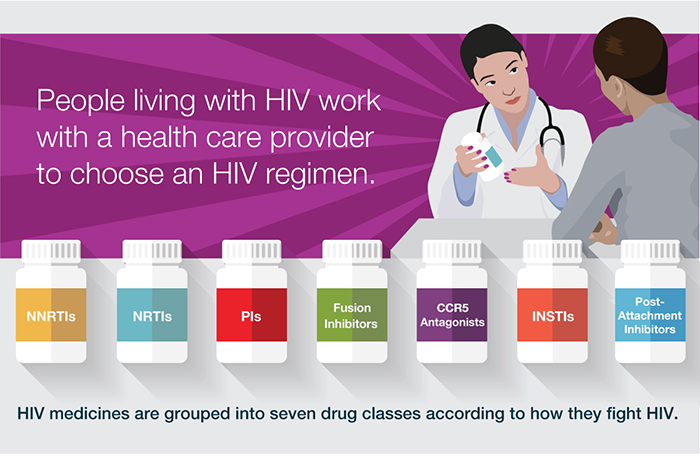
A quick explanation on how each class of drug works:
Non-Nucleoside Reverse Transcriptase Inhibitors (NNRTIs): NNRTIs work by binding to a site in the HIV’s reverse transcriptase enzyme. This binding then causes a change in the DNA binding site in the enzyme, rendering it incapable of binding to the host cell nucleotides and therefore stopping HIV DNA polymerisation. Essentially, NNRTIs are non-competitive inhibitors. For more information on how HIV replicates using its enzymes, please see our other HIV blogs!
Nucleoside Reverse Transcriptase Inhibitors (NRTIs): NRTIs work by mimicking nucleosides, where the reverse transcriptase recognises them as regular nucleosides and inserts them into the newly synthesised HIV DNA chain. However, since these NRTIs lack the required hydroxyl group to form the phosphodiester bonds between nucleosides, the chain “terminates” at this point. NRTIs are therefore a competitive inhibitor.
Protease Inhibitors (PIs): Protease inhibitors work by binding to the catalytic site of the protease, preventing them from cleaving the viral protein chains into mature, functional proteins necessary for viral replication.
Fusion Inhibitors: Fusion inhibitors bind to the attachment sites on the envelope of the HIV-1 virus, preventing them from binding to CD4 cells and merging.
CCR5 Antagonist: CCR5 antagonists block the CCR5 coreceptor on the surface of certain immune cells, such as CD4 T lymphocytes. This prevents HIV from entering the cell.
Integrase strand transfer inhibitors (INSTIs): INSTIs block integrase activity by competitively inhibiting specific catalytic sites within the intasome, a nucleoprotein structure that catalyses integration of DNA.
Post-Attachment Inhibitors: these drugs bind to CD4 cell receptors and prevent HIV proteins from changing its shape to engage with co-receptors.
The vast number of combination therapies now available for patients means that they have greater autonomy and flexibility in choosing a regimen that suits them best, leading to improved quality of life and better patient outcomes.
The Future of Treatments for HIV
Researchers are still finding new ways to combat the virus, such as long acting injectable (LAA) antiretroviral drugs. The expected benefits of LAA include less frequent dosing and reduced “pill fatigue” (the feeling of losing motivation to take frequent pills, also known as “high pill burden”), which would improve adherence issues seen frequently with cART regimens. Other positives would include less drug-drug interactions and reduced adverse events.
Scientists are also looking at HIV vaccines. There are no vaccines approved by the FDA to date for HIV, however they are currently being researched in clinical trials. Both preventative vaccines (your usual vaccine type) and therapeutic vaccines are being researched. Therapeutic vaccines are intended to strengthen the immune response in patients who already have HIV.
In one of the most exciting developments in HIV treatment research, scientists are looking at gene editing to target HIV. Using the clustered regularly interspaced palindromic repeat-Cas system (known as “CRISPR-Cas”), some researchers are trying to target the proviral RNA and DNA, more specifically a sequence of the viral genome that has not evolved historically, so that the virus cannot adapt unless that specific sequence undergoes mutation. There has been lots of data both in vitro and in pre-clinical studies that show great promise, with a 20-fold reduction in viral production and HIV gene expression. Essentially, the technique works by “cutting” the viral RNA/DNA at specific points, disabling the virus’ ability to replicate effectively.
It is clear to see that treatments for HIV patients have advanced at an amazing rate. However, there is still room for improvement.
According to the WHO, between 500,000 – 820,000 people died from HIV-related illnesses in 2023. Whilst this is a 69% decrease from 2004 (the peak of HIV related deaths), it is still a large enough number to cause concern. In September 2015, the UN General Assembly included a target in their 2030 Agenda for Sustainable Development to end the AIDS epidemic as a public health threat.
While it is brilliant being able to discuss the future treatments for HIV and think about the possibility of eradicating the virus, it is worth remembering that if the people most in need cannot access the healthcare or health education they require, then HIV will continue to be a problem. There have been incredible leaps forward in the treatment of HIV/AIDS, yet more can be done.
Please follow this link to visit our main website and find out more about Pharmora!
References
aidsmap. (2024, April). Types of antiretroviral medications. Retrieved from aidsmap: https://www.aidsmap.com/about-hiv/types-antiretroviral-medications
Boskey, E. (2024, November 4). Combination Antiretroviral Therapy (cART) for HIV. Retrieved from Verywellhealth: https://www.verywellhealth.com/what-is-cart-p2-3132623#:~:text=1%20While%20combination%20HIV%20therapies,about%20more%20than%20just%20semantics.
CDC. (2022, August 24). Post-Exposure Prophylaxis. Retrieved from CDC: https://www.cdc.gov/hiv/risk/pep/index.html
CDC. (2022, July 5). Pre-Exposure Prophylaxis. Retrieved from CDC: https://www.cdc.gov/hiv/risk/prep/index.html
CDC. (2023, August 9). HIV Treatment as Prevention. Retrieved from CDC: https://www.cdc.gov/hiv/risk/art/index.html
ClinicalInfoHIV.gov. (2021). HIV/AIDS Glossary: Fusion inhibitor. Retrieved from ClinicalInfoHIV.gov: https://clinicalinfo.hiv.gov/en/glossary/fusion-inhibitor#:~:text=A%20fusion%20inhibitor%20blocks%20the,from%20entering%20the%20CD4%20cell.
ClinicalInfoHIV.org. (2021). HIV/AIDS Glossary: CCR5 Antagonist. Retrieved from ClincalInfoHIV.gov: https://clinicalinfo.hiv.gov/en/glossary/ccr5-antagonist
Hussein, M., Molina, M., Berkhout, B., & Herrera-Carrillo, E. (2023). A CRISPR-Cas Cure for HIV/AIDS. International Journal of Molecular Sciences, 1563.
Jóźwik, I., Passos, D., & Lyumkis, D. (2020). Structural Biology of HIV Integrase Strand Transfer Inhibitors. Trends Pharmacol Sci, 611-626.
LibreTexts Biology. (2022, December 24). 13.7C: Nucleotide and Nonnucleotide Reverse Transcriptase Inhibitors. Retrieved from LibreTexts Biology: https://bio.libretexts.org/Bookshelves/Microbiology/Microbiology_(Boundless)/13%3A_Antimicrobial_Drugs/13.07%3A_Antiviral_Drugs/13.7C%3A_Nucleotide_and_Nonnucleotide_Reverse_Transcriptase_Inhibitors#:~:text=The%20major%20difference%20between%20them,the%20
National Institute of Diabetes and Digestive and Kidney Diseases. (2017, September 1). LiverTox: Clinical and Research Information on Drug-Induced Liver Injury [Internet]. Bethesda (MD)
NIH. (2021, August 16). HIV Treatment: The Basics. Retrieved from HIVInfo.NIH.gov: https://hivinfo.nih.gov/understanding-hiv/fact-sheets/hiv-treatment-basics
NIH. (2024, July 26). What is a Preventive HIV Vaccine? Retrieved from HIVinfoNIH.gov: https://hivinfo.nih.gov/understanding-hiv/fact-sheets/what-preventive-hiv-vaccine#:~:text=Currently%2C%20no%20HIV%20vaccine%20has,(see%20more%20details%20below).
Slama, L., Porcher, R., Linard, F., & et.al. (2023). Injectable long acting antiretroviral for HIV treatment and prevention: perspectives of potential users. BMC Infectious Diseases, 23:98.
WHO. (2024, July 22). HIV – Number of people dying from HIV-related causes. Retrieved from WHO: https://www.who.int/data/gho/data/indicators/indicator-details/GHO/number-of-deaths-due-to-hiv-aids#:~:text=An%20estimated%20420%20000%20%5B340,by%20almost%2055%25%20since%202010.
Head Office Address:
The Motorworks
Chestergate
Macclesfield
Cheshire
SK11 6DU
Registered Addresses:
24 Cornwall Road, Dorchester,
Dorset, DT1 1RX
Tirchonaill Street, Donegal Town,
Co. Donegal, F94 YO21

Email Address: info@pharmora.com
Phone Number: 01625 838382
Company Numbers
Pharmora Ltd, UK: 07313450.
Pharmora Global Solutions Ltd, Ireland: 666814

Contact us.
Use this form to express interest in working for Pharmora or to request a proposal.
